
When one thinks of an African elephant, a familiar grey silhouette comes to mind. But in the vast, sun-baked expanses of Tsavo, nature has added a surprising twist of color. Here, roaming the red-earth plains and dusty riverbeds, are some of the most iconic and unique elephants on the planet—the legendary “Red Elephants” of Tsavo.
For guests of Koki Safaris Ltd, witnessing these magnificent creatures is more than just a sighting; it’s an immersion into a fascinating story of adaptation, resilience, and natural wonder.
A Coat of Many Colors: The “Red” Mystery
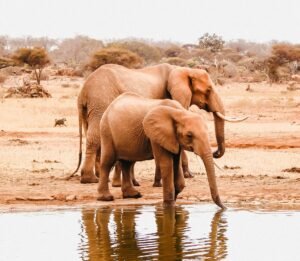
The most striking feature of Tsavo’s elephants is their distinctive reddish-brown hue. But this is no trick of genetics. It’s a magnificent fashion statement courtesy of their environment. Tsavo is famous for its deep, iron-rich red soil. Throughout the day, especially during the dry season, the elephants dust-bathe and spray themselves with this fine red powder. This acts as a highly effective natural sunscreen and insect repellent, protecting their sensitive skin from the harsh equatorial sun and biting pests. Watching a herd wallow at a dust bath, emerging as crimson giants against a green acacia backdrop, is a truly unforgettable spectacle.
Tusks of Legends: Size and Significance
Tsavo has historically been home to some of Africa’s most impressive “tuskers”—bulls with enormously long and heavy ivory. The ecosystem’s mineral-rich soil and specific vegetation are believed to contribute to this remarkable tusk growth. While the era of the great “hundred-pounders” is a cherished part of history, Tsavo still harbors mature bulls with impressive ivory, a testament to the area’s ongoing conservation efforts.
These tusks are not just for show; they are vital multi-purpose tools. Elephants use them for digging for water in dry riverbeds (a critical skill in Tsavo), stripping bark from trees, and as formidable instruments of defense. Observing a bull carefully use his tusks to access water or a mother gently guide her calf is to witness tools of pure survival in action.
Following the Rain: The Tsavo Migration
Unlike the more famous wildebeest migration, the movements of Tsavo’s elephants are a subtler, yet profound, dance with the climate. Their migration is not a single, mass event but a fluid, intelligent response to rainfall and water availability.
Tsavo is divided into East and West, a vast area dotted with seasonal rivers and isolated waterholes. During the long dry seasons, elephants congregate around permanent water sources like the Galana River and Mzima Springs. Here, at Mzima, our guests are often treated to the magical underwater viewing experience, watching elephants swim and drink in the crystal-clear waters.
When the rains arrive, scattering life-giving water across the park, the elephants disperse. They follow ancient, invisible pathways into the drier hinterlands, feasting on the fresh browse that springs to life. This cyclical movement is crucial for the health of the ecosystem, as it allows overused vegetation near permanent water to recover.
Masters of a Harsh Environment
The environments within Tsavo are not for the faint of heart. From dense, thorny scrubland and flat, open plains to dramatic volcanic hills and lush riverine forests, the elephants here are ultimate adapters.
- The Dry Thorn Bush: They expertly navigate this challenging landscape, using their tusks and trunks to access nutrients from seemingly barren plants.
- The Riverine Forests: Along the Galana and Voi rivers, they find shade and richer forage, shaping these woodlands as they move.
- The Lava Flows: They traverse the surreal, rocky terrain of the Yatta Plateau and recent lava flows, demonstrating incredible agility and memory for safe passages.
Their presence shapes the entire landscape, creating water holes, clearing pathways for other animals, and promoting biodiversity—a true keystone species in action.